
To Stay or to Leave: The Question That Haunts Every Employee at Some Point

- Published on the
- Leonilda Renaldo
Table of Contents
Sunday evening. That knot in your stomach is back, along with a question you don’t always dare to put into words: what if I left? Your Emotional Intelligence is telling you something
The good news is that asking yourself this question doesn’t mean you’re stuck. It shows that you have needs, values, and the power to act. Between “staying” and “leaving,” there are far more options than you might imagine: reshaping your role, negotiating, moving up internally, or leaving in a well-prepared way.
In this article, I share insights from work psychology and career coaching to help you go from that knot in your stomach to a clear decision, aligned with your values and your life project.
That Knot in Your Stomach Is Not a Verdict, It’s Information
Doubts about your professional future don’t arise by chance. They are a symptom of underlying tensions in your relationship with work. Several factors add up:
- Loss of meaning (brown-out). When daily tasks no longer offer usefulness, intellectual stimulation, or ethical consistency, a deep cognitive dissonance sets in.
- Imbalance between effort and reward. Investing a great deal of energy without receiving the expected recognition, pay, or security creates an exhausting sense of injustice.
- Frustration of fundamental needs. Self-determination theory (Deci and Ryan) shows that we all need autonomy, a sense of competence, and social belonging. When these needs are stifled, motivation collapses.
- Cognitive biases and fear of the unknown. Our minds tend to favor the status quo. The sunk cost fallacy also pushes us to stay in an unsuitable job simply because we have invested years in it.
To Stay or to Leave: You Have More Choices Than You Think
When faced with dissatisfaction, people generally react in one of four ways: speaking up (Voice), waiting loyally (Loyalty), disengaging (Neglect), or leaving (Exit). To see more clearly, here are two families of signals.
| Signs that call for adjusting | Signs that call for preparing your exit |
|---|---|
| Temporary discomfort or fatigue (workload peak, one-off project) | Damage to physical or mental health (sleep problems, chronic anxiety, burnout) |
| Dialogue with management is possible | Management deaf to your requests, or a toxic climate |
| Needs partially met, skills still stimulated | Structural frustration (underuse of skills, lack of autonomy) |
| Real openness to change, with the possibility of evolving your role | Lasting imbalance between effort and reward despite your follow-ups |
Please note: if you are experiencing symptoms of physical or psychological distress, speak to your doctor quickly. No career decision takes precedence over your health.
External signals don’t tell the whole story. Here is how to listen to what is happening inside.
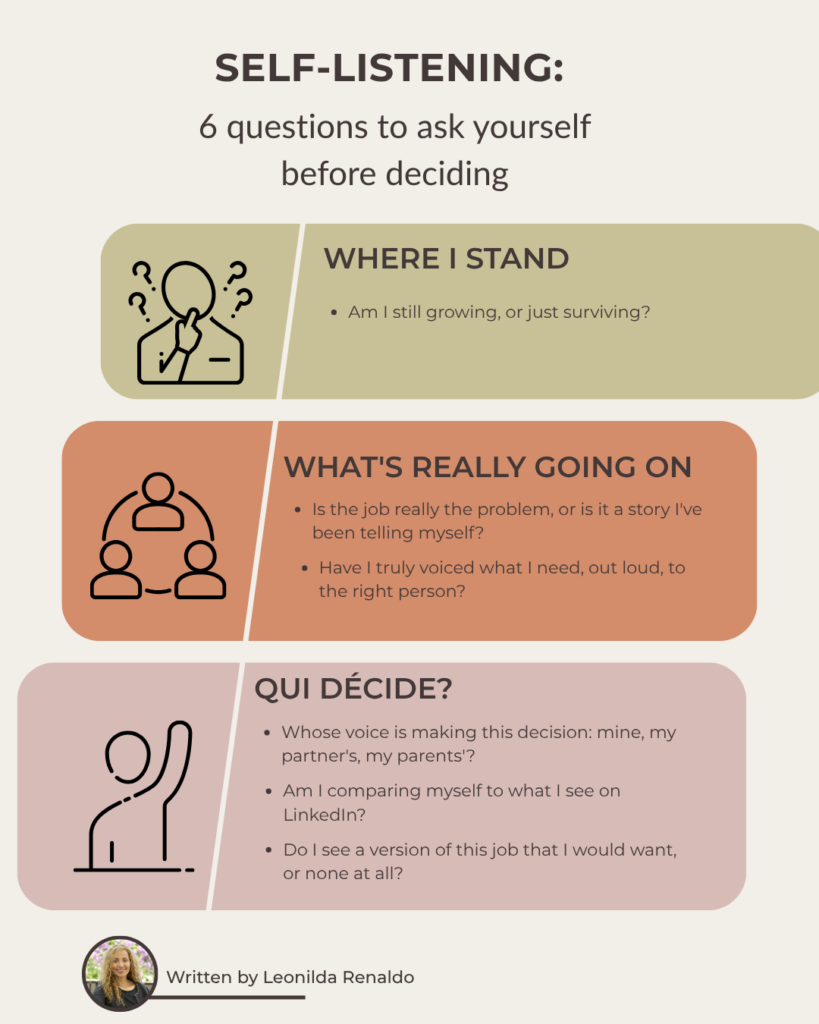
You Have More Options Than You Think
Staying or leaving is not an on/off switch. Between the two, you can:
- Re-enchant your current job (job crafting).
- Negotiate an arrangement (responsibilities, working hours, scope).
- Move up internally (mobility, a new project).
- Leave, but in a prepared and deliberate way.
4 Reflexes That Cost You Your Power to Choose
In times of doubt, decision-making is often distorted by avoidance or overreaction mechanisms:
- Deciding in the heat of the moment. Resigning on impulse after a passing annoyance, with no plan or in-depth analysis.
- Fleeing instead of choosing. Leaving a company solely to escape a constraint, without having defined the direction you want to go in.
- Staying out of fear or comfort. Settling into passive disengagement out of fear of the job market or out of habit, at the risk of damaging your self-esteem.
- Comparing yourself to others. Judging your path by the apparent successes of others, instead of refocusing on your own needs.
Your Emotional Intelligence: A Resource You Already Have
Your knot in the stomach is not a manufacturing defect: it’s a signal. Deciding calmly requires knowing how to listen to it, which is what I call self-listening. Emotional intelligence helps you to name precisely what you feel (fear, anger, weariness, shame?), to tell temporary fatigue apart from a deep misalignment, and to tame the fear of transition so that it doesn’t paralyze your thinking. Above all, it gives you the certainty that you have the resources to reframe your current situation and move from “I endure” to “I choose.”
5 Steps to Take Back Control
- Make an objective assessment. Ask yourself about three points: how well you fit the company culture, the quality of your daily tasks, and how much this job contributes to your life project.
- Take stock of your values and skills. Which skills do you enjoy using? Which values are non-negotiable for you in your daily life?
- Test internal alternatives through job crafting. Before breaking your contract, try adjusting your role. According to Wrzesniewski and Dutton, there are three levers:
- the scope of your tasks (task crafting): proposing new projects or reorganizing your responsibilities;
- your working relationships (relational crafting): changing how you interact with your team or management;
- the perception of your role (cognitive crafting): restoring meaning to your work by linking it to a goal that motivates you.
- Gauge your organization’s receptiveness. Open a constructive dialogue with your management. If they are open, you can co-build the evolution of your role. If they remain closed or inert, you will have confirmation that leaving is the most coherent solution.
- Plan your exit or your negotiation rigorously. If leaving becomes necessary, prepare for it: market research, an inventory of your transferable skills, spotting opportunities, and checking the practical and financial aspects (notice period, your situation regarding
What If You Talked to a Coach?
Sorting through your aspirations and moving past your blocks is not easy when you face the question alone. Based in Lancy (Geneva), the LeoDynamics® center, led by Leonilda Renaldo, a certified coach specializing in public speaking, leadership, intercultural communication, emotional intelligence, and professional English, supports you at every stage of your reflection.
Through our approach to career coaching and leadership development, we help you to:
- identify your motivational drivers and your areas of over-adaptation;
- adopt helpful behaviors to approach the transition with clarity and confidence;
- develop your posture and communication to negotiate an adjustment to your role or succeed in your future interviews.
Taking Back the Power to Choose
There is no universal “right” or “wrong” decision between staying and leaving. The right decision is the one that protects your health, restores your autonomy, and nourishes your fulfillment. But real change begins before the decision: when you move from what is endured to what is chosen.
You are more powerful than you think. Starting this week, you can:
- Name the emotion that dominates when you think about your job;
- Identify one concrete thing you can adjust in your daily routine;
- Plan a conversation, with your management or with a coach.
Whether you choose to re-enchant your current job or open a new chapter, you have the power to take the initiative.
Want to see things more clearly? Contact LeoDynamics® to book a discovery session and take stock of your professional future, with an expert and caring perspective.
Source:
Deci, E. L., & Ryan, R. M. (2017). Self-determination theory: Basic psychological needs in motivation, development, and wellness. Guilford Press.
Hirschman, A. O. (1970). Exit, voice, and loyalty: Responses to decline in firms, organizations, and states. Harvard University Press.
Siegrist, J. (2002). Effort-reward imbalance at work and health. In P. L. Perrewé & D. C. Ganster (Eds.), Historical and current perspectives on stress and health (Vol. 2, pp. 261-291). Emerald. https://doi.org/10.1016/S1479-3555(02)02007-3
Wrzesniewski, A., LoBuglio, N., Dutton, J. E., & Berg, J. M. (2013). Job crafting and cultivating positive meaning and identity in work. In A. B. Bakker (Ed.), Advances in positive organizational psychology (Vol. 1, pp. 281-302). Emerald. https://doi.org/10.1108/S2046-410X(2013)0000001015

Professional Coach in English, Leadership and Emotional Intelligence
Leonilda Renaldo is a professional coach and the founder of LeoDynamics, specializing in business English, executive presence, public speaking and emotional intelligence. Based in Geneva, she supports executives, managers and international teams in developing their confidence, clarity and impact in multilingual professional environments.
Her expertise has been featured in Marie Claire, Yahoo Finance and BSmart, and she has shared her perspective on emotional intelligence as a TEDx speaker.