The Comedy of Consensus: Why Your Teams Pretend to Agree (and What It Really Costs You)

- Published on the
- Leonilda Renaldo
Table of Contents
Monday, 10 a.m. A hushed meeting room or a Teams call. The manager presents a new strategic direction, then asks: “Is everyone aligned?”
Around the table, heads nod and smiles stay polite. No disagreement is voiced, and the project is approved in what looks like a consensus.
Three months later, the project collapses. Behind the scenes, the truth comes out: everyone knew, from day one, that it wouldn’t work.
Why did no one speak up?
In my TEDx talk, “Before AI Rewrites You, Listen,” I asked a question that makes people uncomfortable: why are we training talented professionals to become extras in a comedy of consensus?
In most organizations, we are too quick to label as “shyness,” “lack of confidence,” or “leadership deficit” what is something else entirely: a rational assessment of interpersonal risk. Your teams have learned the lesson:
- taking a pause to think is seen as being unprepared;
- voicing disagreement is seen as a lack of team spirit;
- having an accent or a different voice carries a “credibility cost”;
- imperfection is immediately penalized.
This article has a twofold aim: to give leaders insight into what their posture actually produces, and to give team members concrete tools to speak up without putting themselves at risk. Because the comedy of consensus can’t be undone from one side only. It is together, managers and teams, that we can roll up our sleeves to build learning organizations that move forward intelligently.
Your employees, then, are not passive. They are protecting themselves, lucidly, for their own safety. Yet this survival strategy costs your organizations dearly.
Naming the Trap of Silence: From Politeness to Organizational Anesthesia
This collective habit of performing harmony while doubt is everywhere has already been described under several names:
Toxic empathy. Kim Scott uses this term for the reflex of sparing others’ feelings or avoiding discomfort, at the expense of much-needed criticism. We think we are being “kind.” In reality, we deprive the other person of the means to improve and set the stage for more painful failures.
Organizational silence. Elizabeth Wolfe Morrison and Frances Milliken use this term for a contagious climate in which employees collectively withhold their information, concerns, and ideas. In the study by Milliken, Morrison, and Hewlin (2003), 85% of the professionals surveyed said they had already kept quiet about an important issue for fear of the consequences.
From defensive silence to resigned silence. The work of Pinder and Harlos, followed by Knoll and van Dick, shows that silence often begins as active restraint, motivated by fear of judgment or sanction. When the feeling that “speaking up won’t change anything” repeats itself, it becomes resigned silence, a form of learned helplessness that is disastrous for the company.
When the fear of social risk wins out, the organization sinks into a harmony under anesthesia.
The Real Cost for Managers: The Blind Spots of Power
For a manager, leading in the midst of a façade of harmony is a comfortable but toxic illusion. It creates three major blind spots.
Strategic blindness. Deprived of weak signals and critical feedback, management makes decisions based on embellished data. Major industrial or financial failures, such as those at NASA or Volkswagen, are partly rooted in cultures where the truth no longer traveled upward.
Stifled innovation. Innovating means sharing raw, unfinished ideas. If imperfection is perceived as a risk of appearing incompetent, no one will take the risk of proposing a breakthrough.
Silent disengagement. Being unable to express one’s doubts generates emotional fatigue and cognitive dissonance. The best talents no longer protest: they move from defensive silence to resignation, first mental, then actual.
The Managerial Paradox
Many leaders repeat: “My door is always open, be authentic!”
But what happens when someone walks through that door to deliver bad news or challenge a priority? A frown, a defensive justification, or barely concealed irritation is enough to teach the whole team that authenticity is a trap.
It is not what the manager says that sets the norm. It is what they tolerate, and how they react under pressure. Ray Dalio, founder of the Bridgewater fund, experienced this firsthand. In 1982, convinced that a severe economic crisis was coming, he publicly bet on that scenario. He was wrong, came close to bankruptcy, had to lay off almost his entire team, and borrowed $4,000 from his father. He drew a lesson from it: his certainty had made him deaf to those who doubted. He then built a culture in which disagreement is no longer merely tolerated but expected, and where everyone can challenge their boss’s ideas.
What changes everything in this story is that the silence was not broken by the teams. It was broken by the leader, who decided that contradicting was no longer a risk.
The Mirage of AI: Disappearing Behind the Algorithm
This is where the direct link to my TEDx talk comes in. Out of fear of being judged or perceived as “imperfect,” more and more professionals are taking refuge behind artificial intelligence. They smooth out their writing, erase their style, mask their accent, or offer lukewarm, consensual opinions.
AI then becomes the ultimate shield of façade safety. We disappear behind the algorithm because we have learned that our own voice, with its hesitations, its singularity, and its disagreements, was a risk factor.
But if you use AI to polish your rough edges before you’ve even listened to your own intuition, you are not gaining productivity: you are anesthetizing yourself. Your organization doesn’t need interchangeable employees who validate biased choices with generated sentences. It needs your critical eye.
From Artificial Harmony to Safe Disagreement
Psychological safety was defined by Prof. Amy Edmondson of Harvard. Google’s Project Aristote identified it as the number one factor in team performance. It has nothing to do with niceness or with lowering standards: it is the climate that makes it possible to combine high standards with truly free speech.
For the manager: building the framework
Frame the work as a learning problem. Remind your team that the project involves unknowns and that spotting flaws together is a collective duty, not a lack of loyalty.
Embrace your fallibility. Say openly: “I don’t have all the answers. What am I missing?” The story of Matt Sakaguchi at Google illustrates how a leader’s vulnerability frees up trust across an entire team.
Thank those who raise the alarm. When a team member flags a problem, thank them publicly: “Thank you for raising this so early, this is exactly the courage we need.”
Establish rituals of disagreement. Practice the pre-mortem (imagine the project has failed six months from now and list the reasons together) or the blameless post-mortem after a misstep.
The manager creates the favorable environment (the voice of cohesion) for the team member: to express themselves without putting themselves at risk.
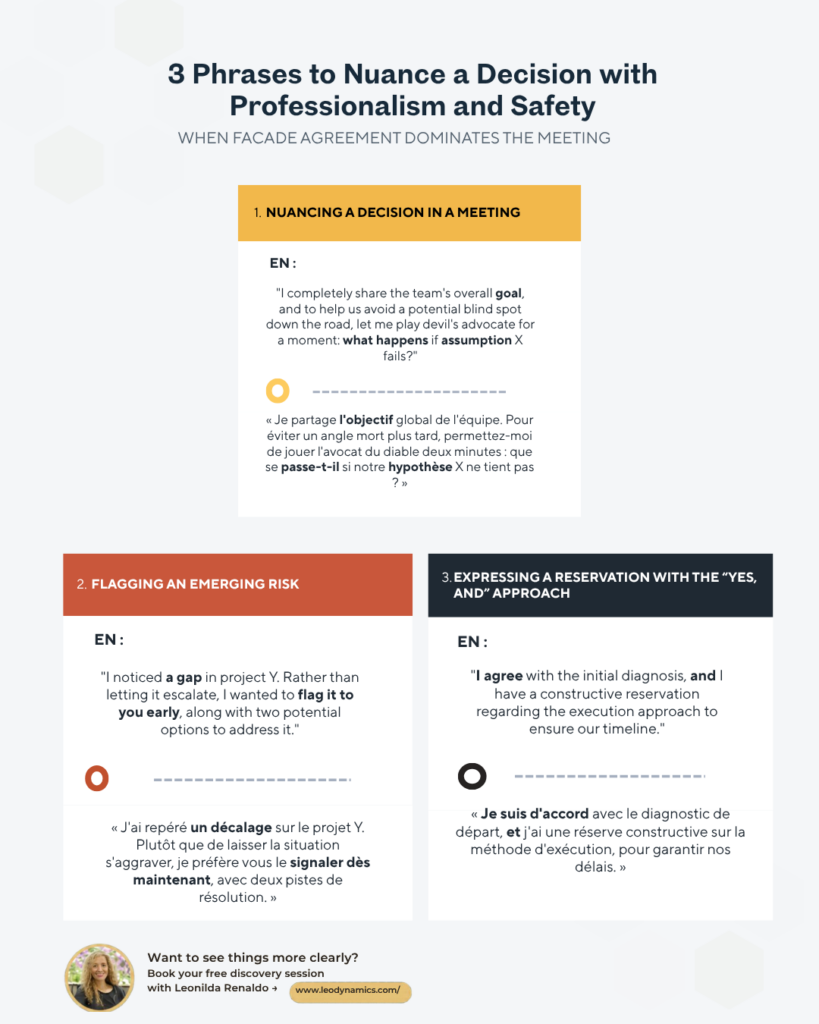
When facade agreement dominates the meeting, here is how to nuance a decision with professionalism and safety.
Telling the Truth Is an Act of Optimism
It is time to step out of the comedy of consensus. Replacing sincere disagreement with fearful politeness has never protected a company from decline.
For leaders and teams alike, let us hold on to this principle: optimism without honesty is not hope, it is avoidance.
Daring to name a project’s flaws or to voice reservations is not being negative. It is believing that the team has the maturity and the talent to face reality and succeed together. It is the first act of optimism of a learning organization.
What If Your Team Took Action?
Changing this dynamic can’t be decreed: it has to be worked on, together. That is precisely what I do in my team coaching. I support your employees and your managers in creating a climate where everyone dares to speak up, nuance, and contradict without fearing for their credibility. The result: more candid meetings, better-informed decisions, and talents who stay because they feel heard.
To go further, watch the full replay of my TEDx talk, “Before AI Rewrites You, Listen.”
Sources :
- Edmondson, A. (1999). « Psychological Safety and Learning Behavior in Work Teams ». Administrative Science Quarterly, 44(2), 350-383.
- Morrison, E. W. & Milliken, F. J. (2000). « Organizational Silence: A Barrier to Change and Innovation in a Pluralistic World ». Academy of Management Review, 25(4), 706-725.
- Milliken, F. J., Morrison, E. W. & Hewlin, P. F. (2003). « An Exploratory Study of Employee Silence: Issues That Employees Don’t Communicate Upward and Why ». Journal of Management Studies, 40(6), 1453-1476.
- Scott, K. (2017). Radical Candor. St. Martin’s Press.

Professional Coach in English, Leadership and Emotional Intelligence
Leonilda Renaldo is a professional coach and the founder of LeoDynamics, specializing in business English, executive presence, public speaking and emotional intelligence. Based in Geneva, she supports executives, managers and international teams in developing their confidence, clarity and impact in multilingual professional environments.
Her expertise has been featured in Marie Claire, Yahoo Finance and BSmart, and she has shared her perspective on emotional intelligence as a TEDx speaker.