
Executive Coach for TEDx: How to Prepare a Talk That Leaves a Lasting Impression
- Published on the
- Leonilda Renaldo
- Photo credit : TEDxGVAGrad
Table of Contents
How to Prepare a Talk That Leaves a Lasting Impression
Do you have an impactful talk coming up? Perhaps you’re afraid of reciting your script like a robot, forgetting your key points, or losing your audience’s attention. Whether you’re preparing for the legendary red stage of a TEDx event or a presentation in front of a room of executives, a memorable message isn’t improvised.
An inspiring speech is built. Storytelling, emotion and stage presence can all be worked on.
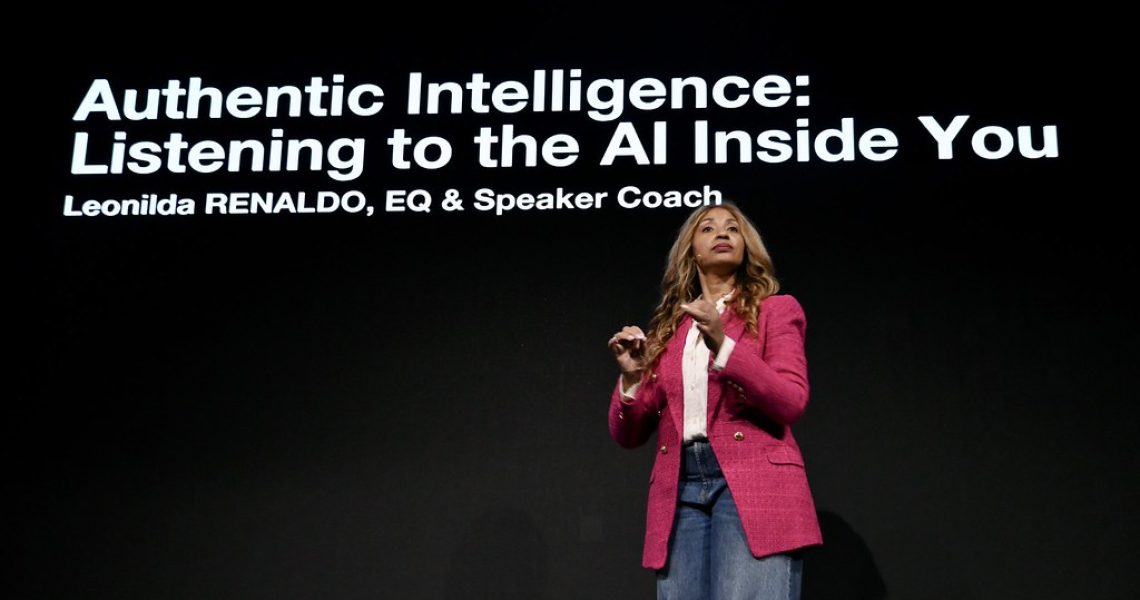
I’m a TEDx coach and the founder of LeoDynamics. I gave a TEDx talk myself in March 2026, and I support executives and business owners in preparing their talks. Here are the key steps I recommend to captivate your audience and leave a lasting impression.
Find a Unique Idea: The Common Thread of Your Talk
The first mistake I see in many speakers? Trying to say too much.
According to Chris Anderson, head of TED, the best talks convey a single central idea: the throughline, or common thread.
So I invite you to start by clarifying your main message in a single sentence. To do this, ask yourself this question: after listening to me, what should my audience feel, understand or do? This intention will guide all your choices. Every example, every anecdote and every figure should then feed this idea and give it value for your audience.
Your goal: to offer your audience a new perspective, capable of changing the way they see the world.
Structure Your Speech with the Dynamic of Contrast
A captivating speech never follows a straight, monotonous line. To hold attention, Nancy Duarte, a presentation specialist, recommends the contrast structure. It consists of alternating between “what is” (the current situation, the obstacles) and “what could be” (the ideal vision, the solutions).
At LeoDynamics, our clients prepare with our SWISS™ method, 100% made in Leonilda :
- Slogan: open with a punchy key phrase that sums up your idea.
- Why: explain why this topic matters to your audience.
- Illustrate: illustrate with examples, stories and figures, breaking your arguments down into logical, easy-to-follow steps.
- Summary: sum up the essentials to anchor the message.
- Slogan: conclude by repeating your key phrase, so that the audience leaves with it.
Tell a Story Rather Than Recite Content
Storytelling is the most powerful persuasion lever I know. A study led by neuroscientist Uri Hasson at Princeton University found that, when a story is well understood, the listener’s brain activity synchronizes with that of the storyteller. The stronger this link, the better the message is understood.
In my public speaking coaching, I rely on the three pillars of Aristotle’s rhetoric:
- Ethos: your credibility and authenticity.
- Logos: the logical, rigorous structure of your remarks.
- Pathos: the emotional connection.
Yet I too often see specialists spend most of their time in logos. They then lose their audience: the audience disengages, and the influence or inspiration they seek to convey is lost. The goal of a talk is to leave a mark on people’s minds, not to pour out your knowledge. With too much information, the audience becomes saturated.
One example speaks for itself. Lawyer Bryan Stevenson received the longest standing ovation in TED history. According to Carmine Gallo‘s analysis, he devoted about 65% of his speaking time to storytelling (pathos).
So, dare to share personal stories and a measure of vulnerability: you humanize your message and give your data a soul.
Master Your Voice, Your Body and Your Stage Presence
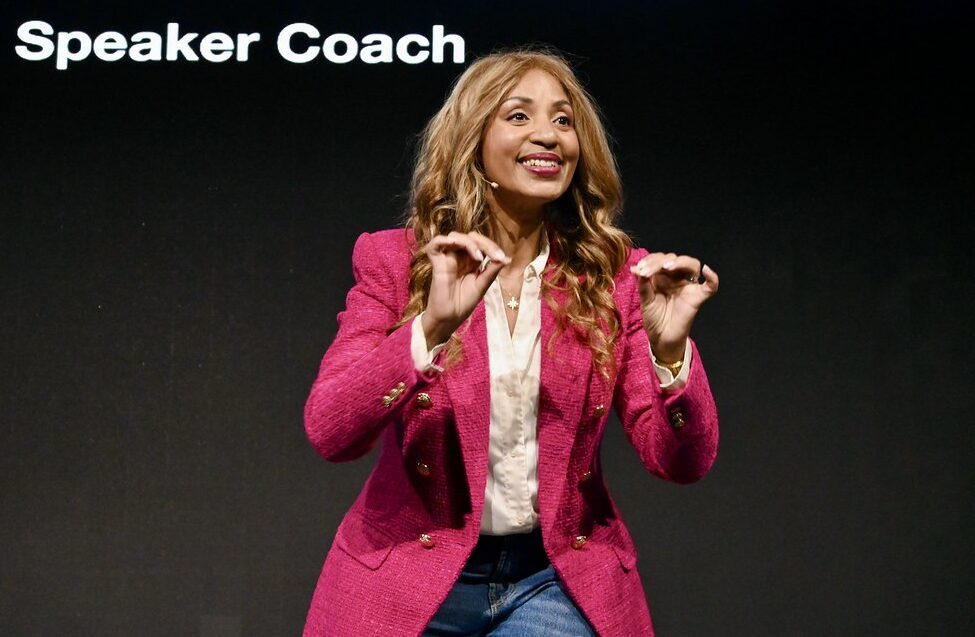
On stage, your body language reinforces the sincerity of your message. Anchor your posture, keep your palms open and hold your audience’s gaze. In doing so, you build a natural relationship of trust.
As for your voice, avoid a theatrical or artificial tone. I recommend a conversational, warm tone, as if you were talking to a close friend. Vary your pace, adjust your volume and don’t be afraid of silences. They are what give your strongest ideas their depth.
Turn Stress into Enthusiasm and Practice
Feeling anxious before going on stage is normal. Yet trying to calm yourself down at all costs is often ineffective.
The work of Alison Wood Brooks, a professor at Harvard Business School, shows that it is more effective to reframe your stress as enthusiasm. Anxiety and excitement are two very similar physiological states. And the brain simply obeys: by saying out loud “I am excited,” you signal to it that this talk matters to you and that you can’t wait to give it. Your mind then shifts from a state of threat to a state of opportunity. The result: more confidence and more power to convince.
Backstage, you can also try the “physiological sigh”: a double inhale through the nose, followed by a long exhale through the mouth. This breathing helps calm the body.
Finally, rehearse your talk out loud until you’ve made the text your own, while keeping your spontaneity.
Why Work with a TEDx Coach?
Building a speech that marks a career requires taking a step back. It is often difficult to isolate the heart of your message on your own or to cut unnecessary jargon.
As a TEDx coach, I bring you a neutral outside perspective and a methodical, tailor-made framework. Together, we can:
- isolate and refine your key idea;
- build a punchy, accessible narrative structure;
- work on your ease on stage and on managing your stage fright;
- make this talk a true springboard for your leadership and your reputation.
Reveal the Impactful Speaker Within You
Leaving a mark on people’s minds when you speak is not an innate gift. It is a skill that can be learned and perfected. With a clear idea, a balanced structure and an authentic narrative, you have all the cards in hand to inspire your audience.
Would you like to prepare your next talk and build an unforgettable presentation? Book your free discovery session with LeoDynamics today. I will support you in captivating your audience from the very first seconds.
Sources :
- Anderson, C. (2013). How to Give a Killer Presentation. Harvard Business Review: https://research.vu.nl/en/publications/the-differential-effects-of-solution-focused-and-problem-focused–2/
- Duarte, N. The ultimate guide to contrast: What your presentation is missing. Duarte: https://www.researchgate.net/publication/352518680_The_effectiveness_of_workplace_coaching_a_meta-analysis_of_contemporary_psychologically_informed_coaching_approaches#pf17
- Carmine Gallo (2014). Talk Like TED: The 9 Public-Speaking Secrets of the World’s Top Minds. St. Martin’s Press.

Professional Coach in English, Leadership and Emotional Intelligence
Leonilda Renaldo is a professional coach and the founder of LeoDynamics, specializing in business English, executive presence, public speaking and emotional intelligence. Based in Geneva, she supports executives, managers and international teams in developing their confidence, clarity and impact in multilingual professional environments.
Her expertise has been featured in Marie Claire, Yahoo Finance and BSmart, and she has shared her perspective on emotional intelligence as a TEDx speaker.