


Emotional Intelligence, the New Professional Essential
For a very long time, professional success was measured almost exclusively by intelligence quotient (IQ), academic degrees, and technical mastery. Yet in an economic environment defined by uncertainty, complexity, and the speed of change, technical expertise is now little more than a baseline requirement. Today, what truly sets an accomplished professional or an inspiring leader apart is their ability to perceive, understand, regulate, and mobilize their own emotions and those of their colleagues.
The good news is that, unlike IQ whose potential typically peaks between the ages of 18 and 20 emotional intelligence continues to grow throughout one’s professional life, provided it is nurtured through targeted effort and a genuine commitment to progress. EQ doesn’t replace IQ; it multiplies its potential. That is precisely the ambition of this guide: to walk you, step by step, toward becoming the professional with amplified intelligence you have the capacity to be.
Empirical research confirms this major shift: according to studies by TalentSmart, 90% of top-performing professionals have a high emotional quotient (EQ). Furthermore, 94% of recruiters and executives now believe that behavioral and relational skills (soft skills) are more decisive for long-term success than technical skills alone. Emotional intelligence (EI) has thus become a key strategic lever for accelerating one’s career, preventing burnout, and building a collective dynamic of excellence.
Understanding Emotional Intelligence: Theoretical Models and Measurement
Emotional intelligence has been the subject of major research since the late 20th century. The scientific literature today identifies three main theoretical approaches to the concept:
- The ability model (Salovey & Mayer) defines EI as a set of mental abilities for processing emotional information, structured into 4 hierarchical branches ranging from perceiving to managing emotions. It is measured objectively through the MSCEIT (Mayer-Salovey-Caruso Emotional Intelligence Test), a performance-based test.
- The mixed and behavioral model (Goleman & Boyatzis) links emotional abilities to observed workplace behaviors and leadership, built around 5 core pillars ranging from self-awareness to social skills. It is assessed mainly through multi-source 360° diagnostics such as the ESCI (Emotional and Social Competence Inventory).
- The trait and emotional quotient model (Bar-On, Petrides) views EI as a set of behavioral dispositions and personality-based self-perceptions related to environmental adaptation. Bar-On’s model holds a particular place in this field: his EQ-i 2.0 (Emotional Quotient Inventory) diagnostic is the first scientifically validated emotional intelligence assessment tool. It is the product of twenty years of research conducted by psychologist and scientist Dr. Reuven Bar-On, whose work spanned eleven countries a truly cross-cultural approach that has made it a reference tool for coaching and personal development today. It is measured through self-assessment questionnaires and inventories such as the EQ-i 2.0 (Bar-On) or the TEIQue (Petrides).
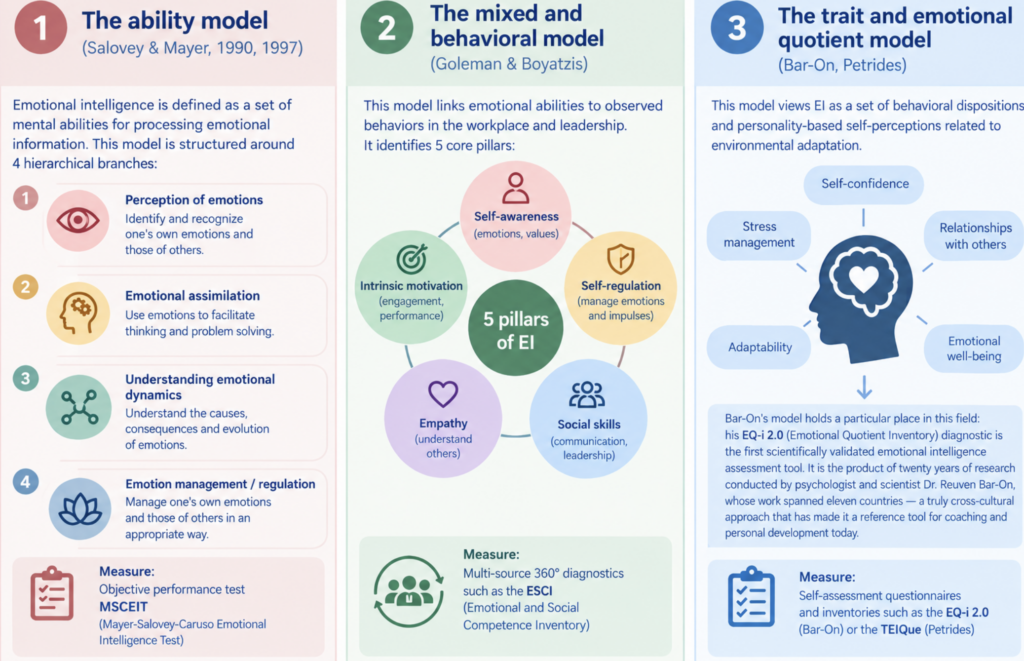
Overview of the three major theoretical models of emotional intelligence, their key components, and their associated measurement tools.
Why Emotional Intelligence Is a Strategic Lever at Work
Rational Decision-Making and Somatic Markers
Contrary to popular belief that pits reason against emotion, the work of neuroscientist Antonio Damasio has shown that emotions are essential to rational decision-making. Through the mechanism of somatic markers, our brain associates past emotional states with choice options. Without the intuitive assessment our emotions provide, the human mind gets trapped in endless analysis and becomes unable to assign concrete value to different alternatives.
Preventing Burnout and Managing Emotional Labor
In their daily work, many professionals encounter the concept of “emotional labor,” a term coined by sociologist Arlie Hochschild. When an organization mandates a specific emotional display (a constant smile, neutrality in the face of provocation), individuals tend to respond in one of two ways:
- Surface acting involves faking the required emotion without actually changing one’s internal feelings. This mismatch creates strong cognitive dissonance and consumes considerable psychological energy, inevitably leading to professional exhaustion and burnout.
- Deep acting involves a deliberate effort of cognitive reappraisal to genuinely align one’s inner state with the demands of the situation. Developing emotional intelligence makes it easier to favor deep acting, protecting an employee’s mental health while preserving relational authenticity.
Psychological Safety and Team Performance
Theorized by Professor Amy Edmondson (Harvard Business School, The Fearless Organization), psychological safety is the shared belief that a team offers a safe space for interpersonal risk-taking. In such an environment, team members feel free to ask questions, flag mistakes, and propose bold ideas without fear of humiliation.
The Practical Guide: 6 Steps to Developing Your Emotional Intelligence
Emotional quotient is not fixed it is a set of malleable abilities that develop through practice and repetition. Here is a structured 6-step method for building new habits at work:
Step 1: Self-Observation and Emotional Journaling
Make it a habit, at the end of each day, to note down 2 to 3 significant moments and attach precise words to the feelings they triggered. Use an emotion wheel to move beyond the vague “I’m stressed” and identify frustration, disappointment, or anxiety instead. This “inner weather check” habit breaks the autopilot mode and sharpens interoceptive awareness.
Step 2: The Attentional Micro-Pause (Mindfulness)
When faced with an irritating email or a provocation in a meeting, the temptation to react impulsively is strong. Give yourself a 5-to-10-second reflex pause: breathe deeply, expanding your abdomen, and observe your bodily tension without judgment. Drawing on mindfulness research (Ilios Kotsou, Jon Kabat-Zinn), this micro-pause allows the neocortex time to temper the amygdala’s impulsive response.
Step 3: Cognitive Reappraisal (Reframing) and Defusion
When facing a difficulty or criticism, practice reassessing the situation from a constructive angle. Ask yourself: “What other interpretation is possible? What can I learn from this?” Apply cognitive defusion by reminding yourself that you are not your thoughts they are simply passing mental events.
Step 4: Active Listening and Decoding Empathy
During a conversation, give your full attention to the other person without preparing your response in advance or interrupting them. Pay close attention to non-verbal cues (posture, tone of voice, gaze), which carry more than 90% of emotional information. Validate the other person’s emotion before sharing your own point of view (e.g., “I understand this situation is causing you concern”).
Step 5: Actively Seeking 360° Feedback
Self-assessment has blind spots. Regularly ask colleagues or managers for honest feedback on how your reactions affect the team. To avoid becoming defensive, welcome this feedback as an opportunity for personal growth.
Step 6: Cultivating Resource Emotions and Gratitude
As highlighted in the work of Rebecca Shankland, cultivating positive emotions gratitude, celebrating wins, kindness strengthens psychological resilience and restores mental energy. Make it a habit to genuinely thank a colleague or build recognition rituals into your team’s routine.
Managerial Posture and Support (Coaching and Training)
Developing emotional intelligence is best supported by a structured organizational framework, because a manager is, above all, a human being not an infallible role model. No one teaches us at school how to regulate our emotions under pressure, defuse a team conflict, or hold space for a colleague’s vulnerability these are skills that must be learned; they can’t be improvised. Expecting a manager to achieve perfect self-regulation without giving them the means to do so sets them up to fail from the start.
The reassuring part is that this learning doesn’t have to happen alone. Structured support genuinely changes the equation: individual coaching to gain perspective on one’s own reactions, training built around role-play and simulated scenarios (such as the CARE program), or peer discussion spaces to share challenges without judgment. It is this collective safety net not individual perfection that turns mistakes into learning opportunities, for both the manager and their team
Take Action
Developing your emotional quotient is an ongoing process, much like training a muscle: it is built step by step, through repetition and self-compassion. By gradually weaving self-observation, the micro-pause, and active listening into your daily routine, you will lay the foundations for a relational posture that is stronger, more authentic, and more inspiring.
But as we’ve seen, this progress doesn’t have to happen alone. Having support dramatically speeds up the journey and turns every challenge into a genuine growth opportunity. That is precisely LeoDynamics’s mission: to offer that space for support whether through individual coaching or group workshops where you can explore your emotions, refine your leadership posture, and fully unlock your professional potential.
What is the first emotional habit you’ll commit to practicing this week at work?
Sources :
Edmondson, A.
What It Is, Why Fear Persists, and What Leaders Can Actually Do, Lean Blog
Simply Psychology – Emotional Labor: Examples & Consequences
Kotsou, I. — Livres
Shankland, R. — Université Lumière Lyon 2, 2023
Goleman, D. — L’Intelligence Émotionnelle

Coach professionnelle en anglais, leadership et intelligence émotionnelle
Leonilda Renaldo est coach professionnelle, fondatrice de LeoDynamics, spécialiste de l'anglais professionnel, de la présence exécutive, de la prise de parole et de l'intelligence émotionnelle. Basée à Genève, elle accompagne des dirigeant·es, managers et équipes internationales dans le développement de leur confiance, de leur clarté et de leur impact en contexte professionnel multilingue.
Son expertise a été mise en avant dans Marie Claire, Yahoo Finance et BSmart, et elle a partagé sa vision de l'intelligence émotionnelle en tant que conférencière TEDx.